SurdaticsSURDATICS

For AI & data teams

Human data you can show a lawyer, not just a model.

Scraped corpora are now a liability with a price tag. What replaces them has to be consented, paid for, and traceable to the people who produced it — and it has to cover the languages and populations the open web barely represents.

Why this is hard right now

Scraped data carries real exposure

Provenance is the first question in any diligence, licensing negotiation or regulatory review. "We found it online" has stopped being an answer.

Evaluation needs real humans

Preference data, red-teaming and model evaluation need actual people with actual context — not synthetic judgements or the same small pool answering everything.

The long tail is missing

Most languages and most populations are thin or absent in web-scale data. The people who could fill that gap are the hardest ones to reach and pay.

What Surdatics gives you

Consent recorded at collection

Every contributor accepts terms before answering, and that acceptance is stored against the response — not asserted afterwards in a policy document.

A fingerprint anyone can verify

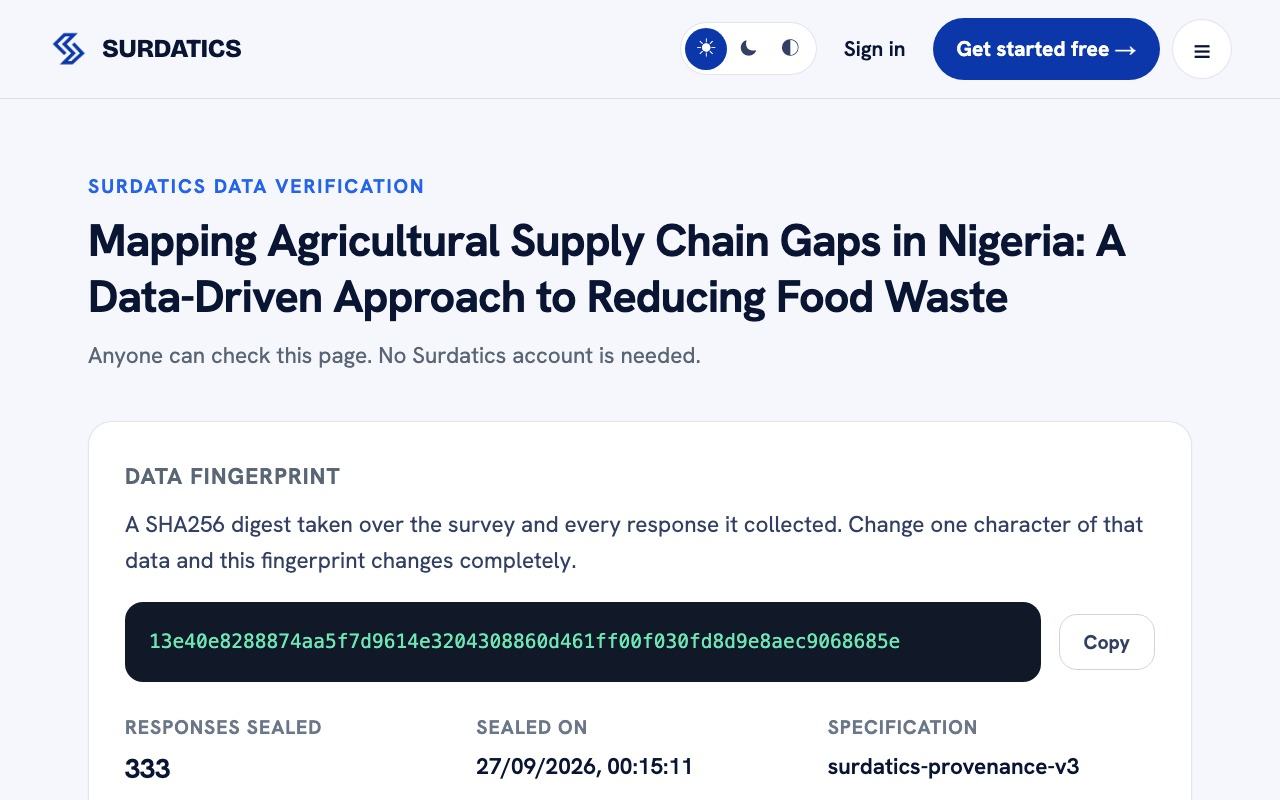
Each sealed dataset carries a SHA-256 digest over its canonical form, anchored to a public ledger. Your counterparty can check it without an account, and without trusting us.

27 languages, 17 of them African

Write an instrument once and field it in the language your respondents think in — including the ones with almost no presence in web-scale training data.

Verified, unique humans

A facial liveness check confirms each contributor is one real person. No ID document, no passport, no name — facial geometry only, and results carry wallet addresses rather than identities.

Contributors are actually paid

Paid on approval, to a local bank account or in stablecoin, including where conventional payment processors do not operate. The payment record is inside the seal, not beside it.

API and webhooks

Create studies and pull responses from your own systems. Webhooks fire on response, approval and dataset sale.

Where the platform stands today

Read live from the platform, not written into this page.

One limit worth stating plainly: a fingerprint proves a dataset has not changed since it was sealed and that its contributors were compensated. It does not prove the sample is representative of any particular population — that depends on how the study was designed, which we will work through with you rather than around.

Check any dataset's fingerprint yourself →

Tell us what you need to measure

Who you need to hear from, roughly how many responses, and where. You will hear back from someone who can actually answer it.

Talk to us about a dataset